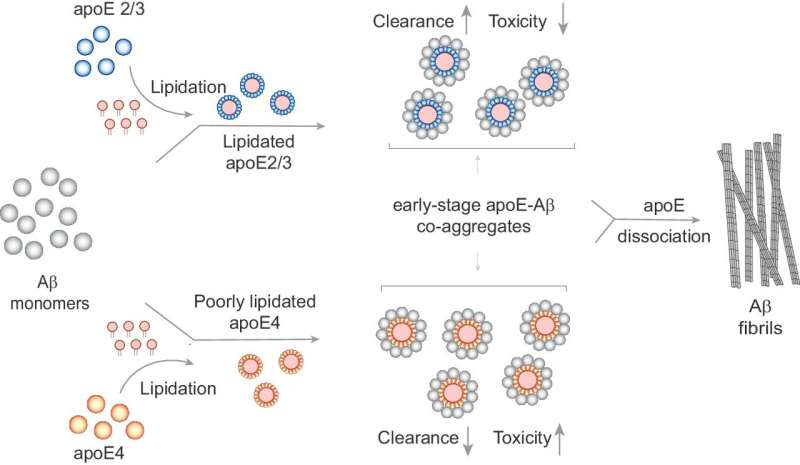
Mechanisms for how apoE influences Aβ accumulation and modulates Aβ clearance and inflammation in an isoform- and lipidation-specific manner. Credit: Nature Communication (2024). DOI: 10.1038/s41467-024-49028-z
Scientists have found a new piece of the puzzle to understand why some people are more susceptible to Alzheimer’s disease. The research was published in the journal Nature Communication.
New research from the University of Sheffield’s Institute of Translational Neuroscience (SITraN), together with scientists from the UK Dementia Research Institute at the University of Cambridge, shows how a dangerous fat called apolipoprotein E interacts (APOE) and a protein called amyloid-beta (Aβ), and how this interaction affects the risk of developing Alzheimer’s disease.
A build-up of Aβ protein in the brain, forming plaques called plaques, is a hallmark of Alzheimer’s. This accumulation begins two to three decades before any symptoms appear, marking one of the first signs of the disorder. sick. This cumulative process damages brain cells and impairs their function, leading to symptoms such as memory loss. Therefore, stopping this accumulation or reducing the toxicity around this accumulation is a special treatment.
A specific gene, called APOE, is the most common gene associated with Alzheimer’s disease. APOE comes in three common forms in humans. APOE2 is associated with a reduced risk of developing Alzheimer’s. APOE3, the most common type, does not appear to affect the risk of the disease. However, APOE4 increases the risk.
About one in seven healthy people carry two copies of the APOE4 gene. However, in people diagnosed with Alzheimer’s disease, one out of every 2.5 patients carries this gene, which confirms the high risk of developing the disease.
Sheffield scientists linked these two factors to Alzheimer’s disease—how the inherited APOE gene is linked to the development of four Alzheimer’s disease by characterization of Aβ formation.
They used a new method by converting human skin cells into a type of brain cells and removing Aβ protein deposits from the brains of innocent people. There are different versions of the APOE gene.
They found that all forms of the APOE gene interact with the Aβ protein during the early stages of its accumulation. However, the APOE4 gene mutation causes more damage to Aβ in brain cells and accelerates its formation compared to other gene mutations.
The senior author of the study, Dr. Suman De from the University of Sheffield’s Institute for Translational Neuroscience (SITraN), said, “The most interesting thing about our findings is that we know a specific target-APOE4-Aβ co-aggregates or aggregates. By focusing on removing these particles, we can reduce Aβ damage to brain cells, improve the clearance of toxic Aβ, and slow down its accumulation.
“This opens up the possibility for new treatments targeting these specific protein clusters, offering a new way to combat Alzheimer’s disease.”
Recently, two different treatments for the removal of amyloid clumps from the brain of Alzheimer’s patients have been approved by the FDA, providing new hope in combating this debilitating condition. However, their effects are modest, especially for patients with APOE4 genes.
One of the reasons is that these treatments are usually carried out in the last stages of the disease when many brain cells have already been damaged due to the Aβ buildup process.
This study provides an understanding of how APOE affects the aggregation of Aβ at the beginning of the disease and shows that the selection of negative Aβ clumps that interact with APOE4 can reduce the loss. the brain and accelerate the clearance of amyloid from the brain.
Scientists hope that future research could lead to targeted therapies, especially for patients with the APOE4 gene, to slow or stop the progression of Alzheimer’s disease. Although this research is in its infancy, it represents an important step forward in our understanding of Alzheimer’s disease.
Dr. added. De, “This study explains why individuals with a specific variant of the inherited APOE gene are at greater risk of developing Alzheimer’s.
“Although this risk associated with the APOE gene has been known for many years, our study sheds light on the specific mechanisms by which different variants of the APOE gene lead to the accumulation of Aβ and thus affect the likely to develop the disease.”
The study was conducted in collaboration with the University of Cambridge, Washington University School of Medicine, and the University of Eastern Finland.
More info:
Zengjie Xia et al, Interaction with Apolipoprotein E modulates the function of Amyloid-β in Alzheimer’s disease, Nature Communication (2024). DOI: 10.1038/s41467-024-49028-z
Presented by the University of Sheffield
Quote: New genetic clues to understanding increased risk of Alzheimer’s (2024, June 21) retrieved 22 June 2024 from https://medicalxpress.com/news/2024-06-genetic-clue-alzheimer.html
This document is subject to copyright. Except for any intended use for the purpose of private research or study, no part may be reproduced without written permission. . The content is provided for informational purposes only.
#information #based #knowledge #risk #Alzheimers #increased