image:
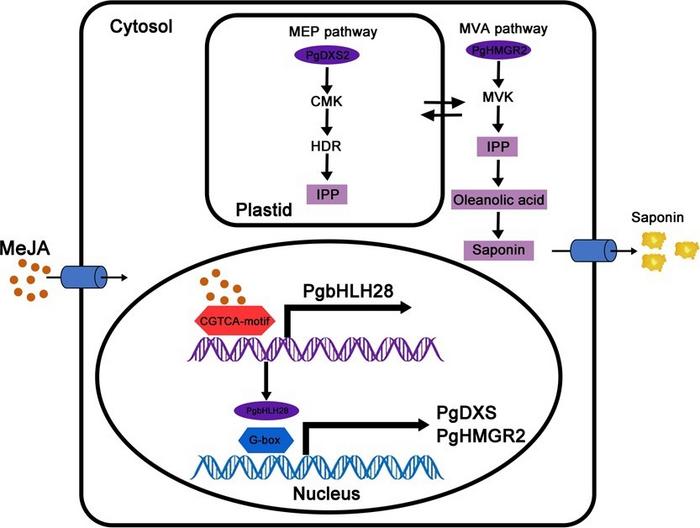
Working example a PgbHLH28 in the regulation of saponin biosynthesis c P. grandiflorus. PgbHLH28 specifically with the induction of key structural genes involved in saponin biosynthesis (including PgDXS2 and PgHMGR2) and activate their transcription, resulting in the improvement of the saponin content P. grandiflorus. In addition, the intermediate products produced by the MVA and MEP pathways can be used in both pathways through transmembrane transport.
perspective more than
Subject: Agricultural Research
A systematic study identified the PgbHLH28 gene as an important factor in methyl jasmonate-induced (MeJA-induced) saponin biosynthesis in Platycodon grandiflorus. This basic information can greatly enhance the production of saponins, which is useful in the prevention of cerebrovascular diseases and COVID-19, offering a new medical approach to plant cultivation.
Platycodon grandiflorus, commonly known as balloon flowers, is famous for its special medicinal properties, due to the abundance of saponin. Saponins are known for their anti-inflammatory, anti-cancer, and immune-enhancing properties P. grandiflorus an important plant in traditional medicine. However, challenges such as low saponin availability and poor agricultural practices hinder its widespread use. Addressing these issues is important for improving the effectiveness of pesticides and the quality of agriculture. P. grandiflorus. Because of these challenges, it is necessary to study the genes and molecules that control saponin biosynthesis to develop high quality crops.
Researchers at Northeast Agricultural University, in collaboration with the Key Laboratory of Cold Region Landscape Plants and Applications, have published a study (DOI: 10.1093/hr/uhae058) in Agricultural Research on February 28, 2024, explains how the use of methyl jasmonate (MeJA) stimulates the expression of PgbHLH28 gene, an important regulation in the accumulation of saponins.
The study focused on understanding how MeJA affects saponin biosynthesis in P. grandiflorus. The researchers used different measures of MeJA i P. grandiflorus roots and found that the concentration of 100 μmol/l was optimal for saponin production. RNA sequencing analysis showed that the PgbHLH28 plays an important role in this process. Overstatement of PgbHLH28 inside P. grandiflorus it caused an increase in saponin content, while removing the fat prevented saponin synthesis. Further studies using yeast one-hybrid and two luciferase assays showed that PgbHLH28 linked directly to the promoters of the PgHMGR2 and PgDXS2 genes, activating their expression and enhancing saponin biosynthesis. These findings establish a complex regulatory network involving MeJA and PgbHLH28which controls the production of internal saponins P. grandiflorus. The study not only elucidates the basic process underlying the saponin biosynthesis but also provides a basic framework for the improvement of the saponin content. P. grandiflorus through genetic engineering and agricultural practices.
Said Dr. Tao Yang, an expert in plant biotechnology and one of the corresponding authors of the study, “Our research marks an important advance in the understanding of the regulation of saponin biosynthesis in . P. grandiflorus. The disclosure of PgbHLH28 as a key regulator opens new opportunities for improving the medicinal value of this plant through genetic modification. This research provides an important basis for the development of high-saponin products, which can have great implications for the clinic.
The implications of this research are far-reaching for both agriculture and medicine. By using the information obtained from this research, scientists can develop new crops of P. grandiflorus with improved saponin content, thus increasing the medicinal value of the plant. This could lead to more effective natural treatments for a variety of health conditions, including inflammatory and viral diseases. In addition, understanding the regulation of saponin biosynthesis can help in the development of other drugs, promote the use of special substances in modern medicine and may lead to new research.
###
Identity
DOI
10.1093/h/uhae058
Original Source URL
https://doi.org/10.1093/hr/uhae058
Financial information
This work was supported by the National Natural Science Foundation of China (No. 31971700) and the Joint Research Program of the Science Foundation of Heilongjiang Province (No. LH2020C014).
About Agricultural Research
Agricultural Research is an open access journal of Nanjing Horticultural University and ranks number one in the Horticulture category of Journal Citation Reports™ from Clarivate, 2022. The journal is dedicated to publishing original research articles, reviews, perspectives, information, articles and letters to the editor related to major horticulture and education, including biotechnology, agriculture, cellular and molecular biology, evolution, genetics, inter-species interactions, physiology, and the origin and importance of agriculture.
Writer
Agricultural Research
Subject of Study
Not applicable
Subject Headings
The RNA sequencing analysis shows that PgbHLH28 is the main regulator in response to the accumulation of saponin by methyl jasmonate in Platycodon grandiflorus.
News Release Date
1-May-2024
COI Information
Authors say they have no preferences.
Labels: AAAS and EurekAlert! is not responsible for the accuracy of the advertisements posted on the EurekAlert! through corporate entities or using any information through the EurekAlert system.
#insights #methyl #jasmonateinduced #saponin #biosynthesis #balloon #flower