
When illuminated with infrared light, certain molecules such as metal phthalocyanines vibrate and generate small localized magnets. The researchers have determined these effects and hope to test them and use these fields for practical applications in quantum computing. Credit: SciTechDaily.com
Doctors at TU Graz have established that certain molecules can be excited by pulses of infrared light to create tiny magnets. If experimental experiments are also successful, this method can be applied to quantum computer circuits.
When molecules absorb infrared light, they begin to vibrate as they gain energy. Andreas Hauser from the Institute of Experimental Physics at the Graz University of Technology (TU Graz) used this well-understood process as a basis for investigating whether these vibrations could be used to produce magnets. Since atomic nuclei carry a positive charge, the movement of these charged particles causes the creation of a magnet.
Using the example of metal phthalocyanines – pure, white molecules – Andreas Hauser and his team now estimate that, due to the high in their form, these molecules actually generate tiny nanometer-sized magnets when infrared pulses are directed at them.
According to the calculations, it should be possible to measure the local energy very low using nuclear magnetic resonance. The researchers have published their results in the Journal of the American Chemical Society.
Circle Dance of Molecules
For the estimate, the team carried out works dating back to the early days of laser technology, some of which are ten years old. They also used state-of-the-art electron microscopy at the Vienna Scientific Cluster and TU Graz to calculate how phthalocyanine molecules behave when ignited in circularly polarized infrared light. The incident is a circularly polarized, i.e. helically twisted, light wave that excites two molecular vibrations simultaneously at right angles to each other.
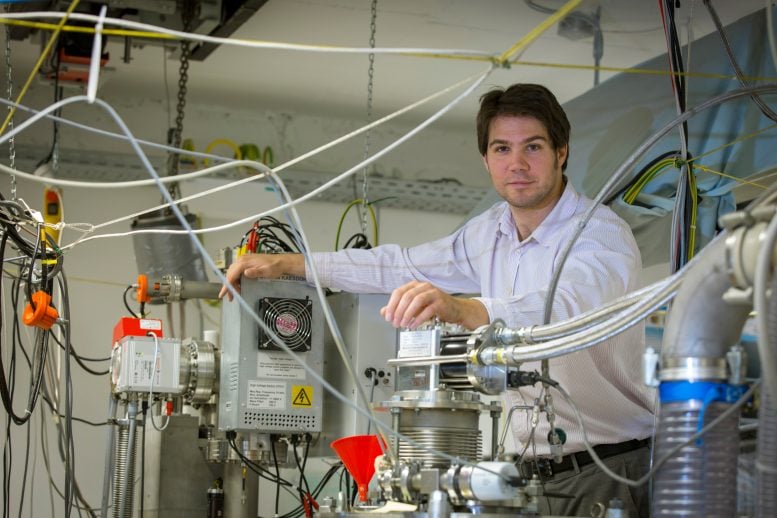
Andreas Hauser from the Institute of Experimental Physics at TU Graz. Details: Lunghammer – TU Graz
“As all couple rumba dancers know, the correct combination of front-back and left-right creates a small closed loop. And this circular movement of each atomic nucleus is affected to actually create a magnet, but only locally, with measurements between a few nanometers,” said Andreas Hauser.
Molecules as Circuits in Quantum Computers
By using infrared light, it is also possible to control the strength and direction of the magnet, explains Andreas Hauser. This would turn molecules into high-resolution optical probes, which might even be used to build circuits for a quantum computer.
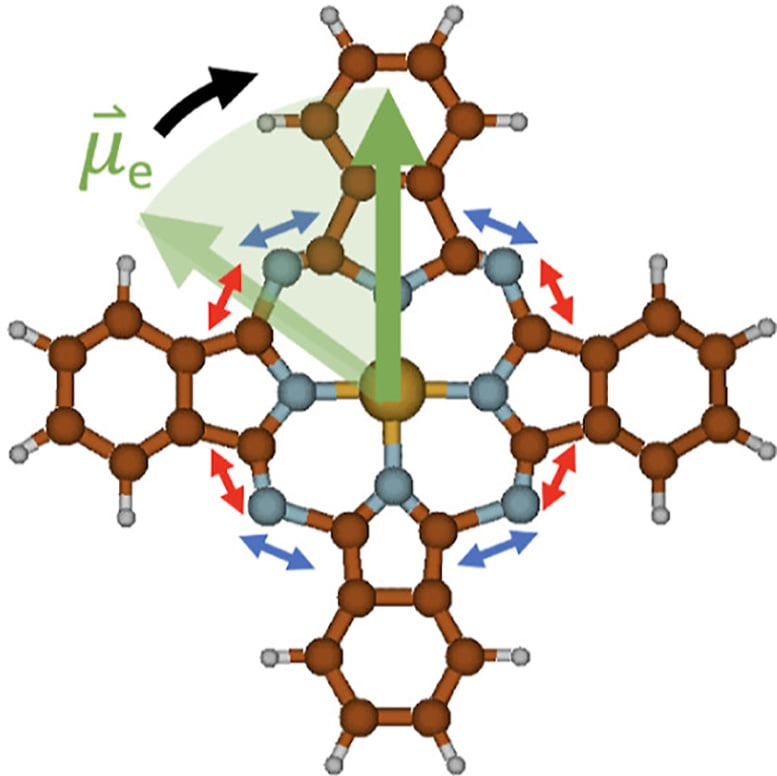
Schematic diagram of a metal phthalocyanine molecule placed in two vibrations (red and blue), generating an electric dipole moment (green) in the molecular plane and thus a magnet. Reference: Wilhelmer/Diez/Krondorfer/Hauser – TU Graz
Example of the Next Step
Together with his colleagues from the Institute of Solid State Physics at TU Graz and a team at the University of Graz, Andreas Hauser now wants to prove experiments that can produce magnetic molecules in a controlled manner.
“For confirmation, but also for future applications, the phthalocyanine molecule needs to be placed on the surface. However, this changes the physical conditions, which affects the stimulation of light and magnetic properties,” says Andreas Hauser. “So we want to find a support material that has the least impact on the desired mechanism.”
In the next step, the doctor and his colleagues want to compare the interaction between the stored phthalocyanines, the support material, and the infrared light before giving the best changes to the test in the tests.
Comment: “Molecular Pseudorotation in Phthalocyanines as a Tool for Magnetic Field Control at the Nanoscale” by Raphael Wilhelmer, Matthias Diez, Johannes K. Krondorfer and Andreas W. Hauser, 14 May 2024, Journal of the American Chemical Society.
DOI: 10.1021/jacs.4c01915
The study was funded by the Austrian Science Fund.
#Doctors #Find #Path #Quantum #Computing #Infrared #Illumination