Scientists may have figured out how supermassive black holes grow.
A strong magnetic wind that swirls around these cosmic collisions like water around a mound may allow them to grow to their massive sizes, according to a new paper in the journal profile. Astronomy and Astrophysics.
This process may be similar to that involved in the birth of stars, the researchers suggested.
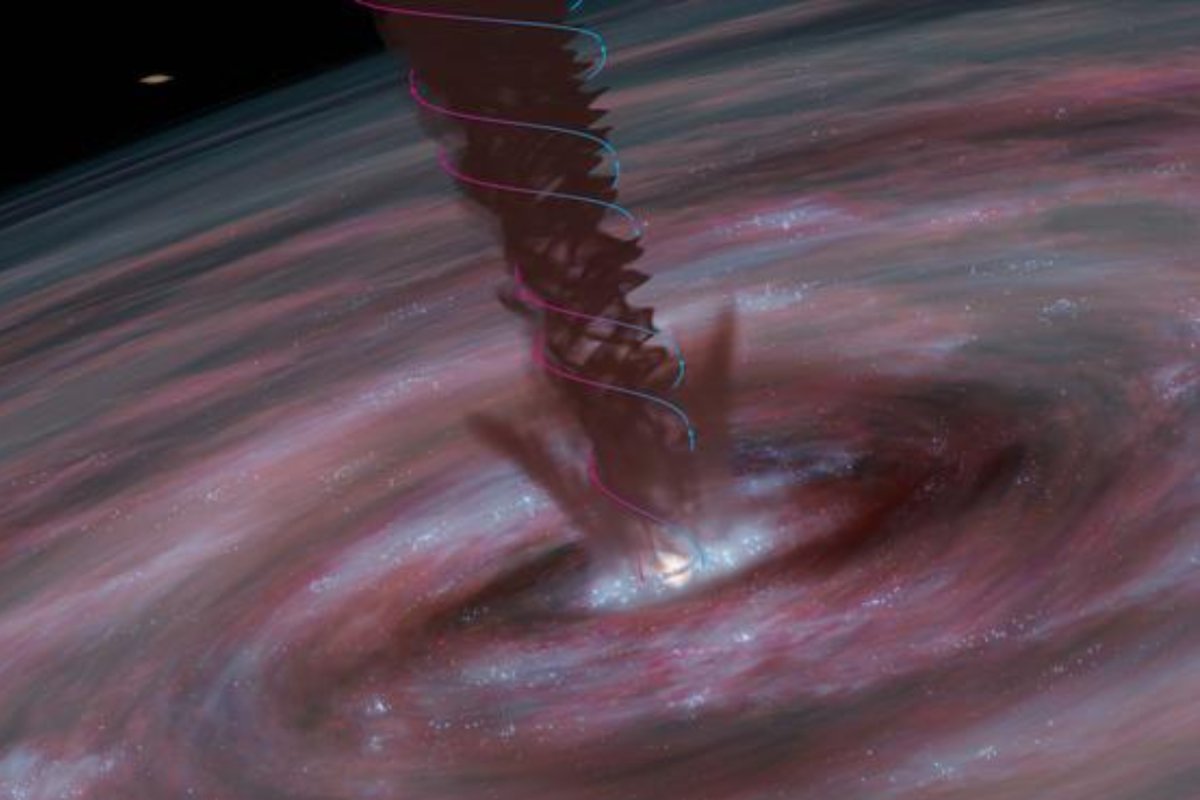
MD Gorski / Aaron M. Geller, Northwestern University, CIERA, the Center for Integrated Research and Research in Astrophysics.
Supermassive black holes are a class of supermassive black holes, often millions to billions of times the mass of our sun. They are often found in the centers of many galaxies, including our own—the galaxy at the center of the Milky Way called Sagittarius A*.
In the paper, the researchers explained how they studied the black hole at the center of the galaxy called ESO320-G030, which is about 120 million light years away from us. This galaxy is more energetic than our own, forming new stars at a rate about 10 times greater than the Milky Way.
Supermassive black holes usually have a very large disk at the event horizon, which heats up to high temperatures and emits radiation. Researchers took a closer look at the dense gas surrounding the black hole at the center of ESO320-G030 using the Atacama Large Millimeter/submillimeter Array (ALMA) telescope, and found that it has a strong wind. , moving, magnetically rotating.
“Since this galaxy is very bright in the infrared, telescopes can resolve the spectacular information in its center. We want to measure the light from the mobile molecules that wind from the center of the galaxy, with the aim of find out how the winds are driven by a growth, or in the near future. Using ALMA, we were able to study the light from behind the thick layer of dust and gas,” said a study author Susanne Aalto, a professor of radio astronomy at Chalmers University of Technology, in a statement.
This new wind can push matter into the black hole, causing it to grow slowly.
“We can see how the wind creates a spiral structure, radiating from the center of the galaxy. The wind, forming stars for example, the outflow can be strengthened by the flow of gas. and seem to be held together by magnets,” Aalto said.
This process is similar to the formation of new stars and planets, with a cloud of gas and matter slowly accreting due to gravity.
“It is well known that stars in the early stages of their evolution grow with the help of rotating winds—accelerated by magnetism, just like the wind in this galaxy. Our observations show that they can grow “massive black holes and small stars go through the same process, but on different scales,” said study author Mark Gorski, an astronomer at Chalmers University of Technology and Northwestern University, in the statement.
The researchers hope to study supermassive black holes at the center of other galaxies to confirm whether this mechanism is real and how supermassive black holes grow to their massive sizes.
“Far from all questions about this process to be answered. In our observations we clearly see a rotating wind that helps to control the growth of the central black hole of the galaxy. Now we know The next step is to find out if this is the case and if all galaxies have black holes happen to them?” Gorski said.
You have a reference to a science fiction story Newsweek should it be covered? Do you have a question about supermassive black holes? Report via science@newsweek.com.
Uncommon knowledge
Newsweek is committed to challenging conventional wisdom and finding connections in search of the common.
Newsweek is committed to challenging conventional wisdom and finding connections in search of the common.
#Astronomers #solve #mystery #black #hole #growth